Opportunity Cost, The Power to Consistency Curve, and Splashing Responsibly
By Stancil9
In a 2016 interview with the Legacy’s Allure podcast, Maverick legend Tom Herzog shared some wisdom about his views on how a deck as fair as Maverick is able to win in a format as unfair as Legacy.
“The thing that makes Maverick good is its consistency. Maverick is a fair deck, so when people try to take Maverick and do combos or cute tricks, those tricks are good, but you’re getting away from how the deck wins. The deck wins through its consistency and its ability to always put forth threats and always have good draws. So when you put in cute cards or combos, you can fit them in, but it’s really not helping you in the long run.” – Tom Herzog
Despite all of the changes to Legacy, this still rings true over a decade later. Maverick is most successful when it is able to leverage its consistency, present threats, and draw well in many stages of the game. In the process of adapting the deck to 2026 Legacy, I have tried my hardest to keep this core tenet of consistency in mind.
Three-color versions of Maverick are a bit antithetical to Tom’s ideology of winning through consistency. It’s evident when looking at his 5-0 lists from 2020 and 2021 which had 5 basics in total (3 Forest, 2 Plains) in his GW build. By playing three colors, you are inherently making concessions to your consistency and ability to always put forth threats. Missing colors, being unable to cast spells off of just basic lands, and opening yourself to Wasteland are all prime ways to lose games. Therefore, if you’re going to splash, you also have to find ways to mitigate the downside of your worsened mana. You must make concessions elsewhere in deckbuilding in order to play into Maverick’s strengths as an archetype.
So if adding colors to Maverick pushes the deck away from its strengths, why do it?
The answer is simply that having access to three colors is more powerful than having access to two. (Note that “power” in this context is being used very broadly; flexibility, strong individual threats/answers, and an increased pool of playable cards all fall under the scope of “powerful”).
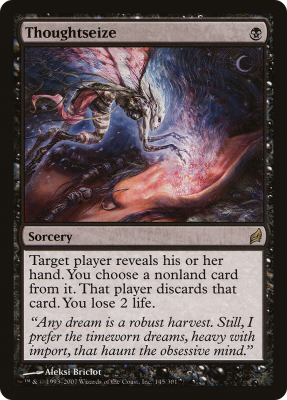
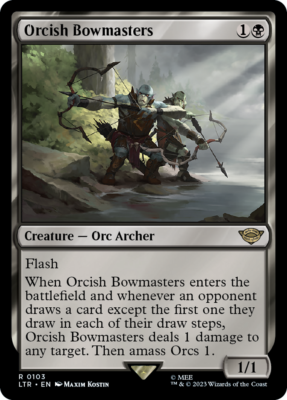
Green/White cannot cast Thoughtseize or Orcish Bowmasters, so the choice to play Abzan is a gamble that Thoughtseize and Orcish Bowmasters are going to win more games for you than worsening your mana base is going to lose you. By splashing, we are trying to find the point on the power-to-consistency curve that maximizes the power of our deck while minimizing the consistency issues that come with adding the third color. Choices we make in deckbuilding affect where we fall along the curve.
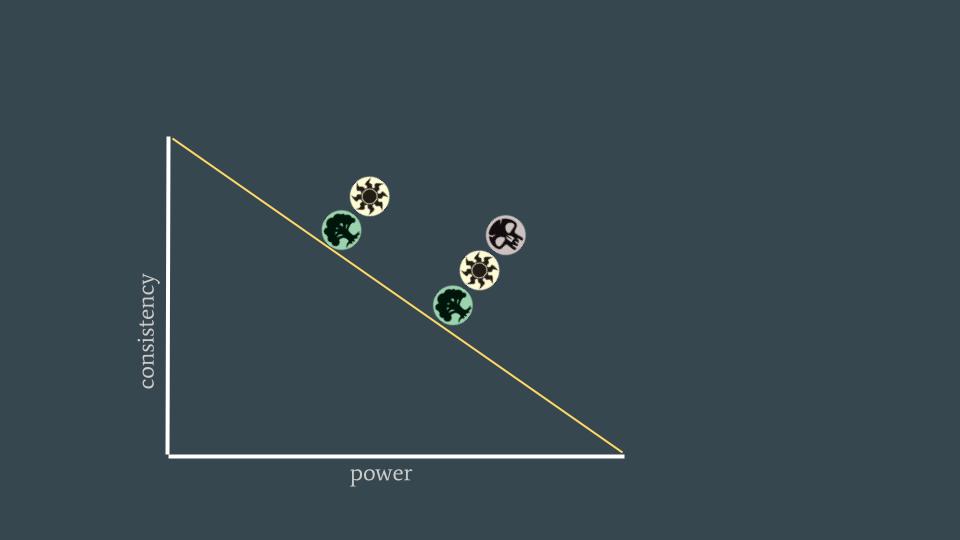
To hone in a bit on what it means to have “consistency” in Maverick, there are two things I like to focus on:
1) being able to cast a mana dork on turn one, and
2) being able to cast your spells on curve.
Almost all of your most impactful starts begin with a mana dork. Therefore, deckbuilding should be heavily biased towards ensuring that happens. Any land that doesn’t cast a dork on turn one should fall under heavy scrutiny. It is pushing you down the consistency axis, and if it doesn’t bring enough power to push you back to the equilibrium line, it’s not going to be beneficial for you in the long term. Mulliganing hands because you can’t cast a dork on T1 is incompatible with the idea of Maverick being a deck that thrives off of consistency.
To the second point, Legacy is a fast and unforgiving format. There are oftentimes not enough turns in a game to afford to stumble on turns 1-3 with a fair deck like Maverick. The ability to cast your spells on curve during turns 1-3 is paramount. For this reason, any land that enters tapped should also fall under heavy scrutiny.
The power/consistency curve sounds great in theory, but what does that actually mean?
The first thing to keep in mind is that you don’t want to be putting black cards in your deck. You should only be putting a black card in your deck if it’s going to have an impact on winning that a green or white card couldn’t. This is because black cards make your deck less consistent, so they only warrant inclusion if they make a big impact.
Thoughtseize is a great example of this. There is no analog for a turn one Thoughtseize versus a deck like Show and Tell. The power that Thoughtseize brings to the deck outweighs the potential mana issues that come with the splash if you’re expecting to play against Show and Tell. The inverse is also true. Putting Bayou into your deck and adding Thoughtseize to your sideboard for the Show and Tell matchup does not justify also throwing in one Wight of the Reliquary or a few Barrowgoyfs. While those cards are powerful, their power over replacement is not high enough to make up for the cost of running black. This is especially true when you consider that the more black cards you add, the higher the cost of their inclusion gets.
My list only runs four black cards in the maindeck and four in the sideboard. This allows me to almost never need to proactively put a black-producing land onto the battlefield. If I have a black card in hand, I’ll fetch for black, but otherwise I can protect my mana by only fetching when needed while playing a majority of the game on stable G/W mana. Limiting the number of splash cards is a commitment to Maverick’s core strategy.
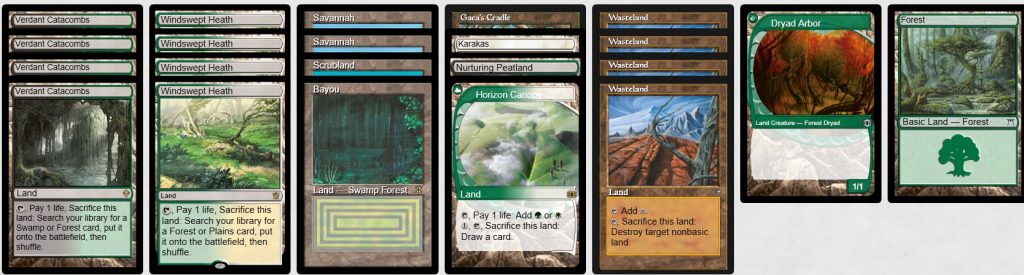
Now that we’ve discussed being conscientious of the splash spells that are going in the deck, let’s take a look at the lands we’re using to cast them.
In the same way that we use the power/consistency scale for spell choices, we can do the same for our manabase. For the sake of this article, we’re going to ignore Wasteland and Dryad Arbor. Those are both taking up spell slots in the deck and therefore don’t count against the manabase. Of the other 17 lands shown, 14 of them are focused on “consistency” and only 3 are cheating on consistency for the sake of power. Let’s look at where those three lands fall on the power/consistency curve.
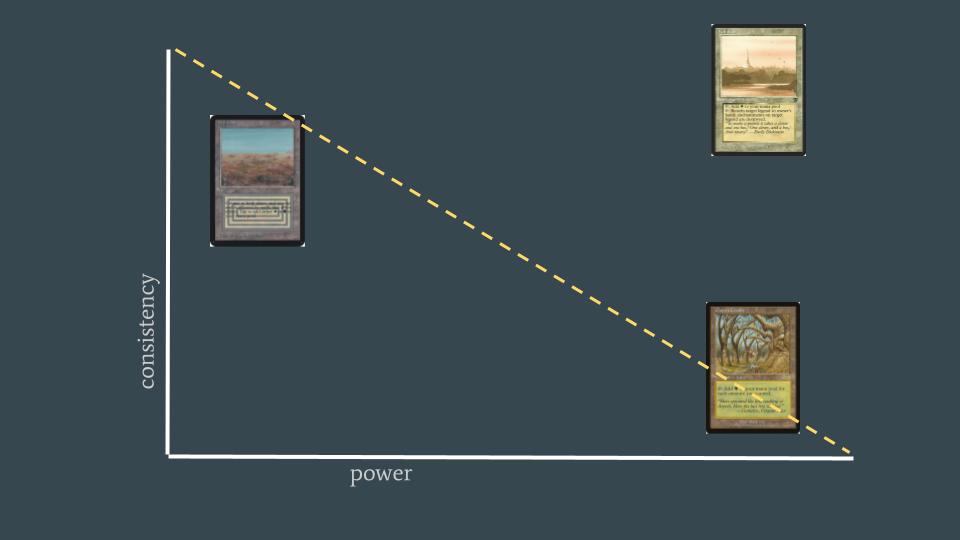
So why are these three lands allowed to break the rules?
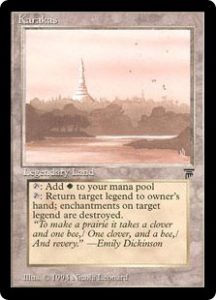
Karakas has such a high floor. It is in your core colors, enters untapped, offers free uncounterable removal, protects your own legends, is strong vs combo and midrange, etc. etc. All of these factors lead to me putting Karakas near the top right corner, well above the power/consistency curve. Its knock is that it doesn’t produce green on turn one. Despite that, the power justifies the risk to your consistency.
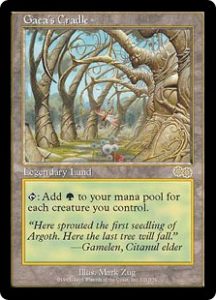
Gaea’s Cradle is a little more dubious. The floor is so much lower than Karakas, especially in a deck like Maverick that isn’t able to spam the board. It has such a high ceiling, though, that in my personal lists I think it warrants inclusion. Cradle actually can fall into both categories we try to avoid when shooting for consistency. It never taps for green on turn one and sometimes prevents us from playing out spells on curve. I’ve placed it in the bottom right on the graph. It will reduce your deck’s consistency, but when it is good, it will also win some games that no other card could. I see playing Gaea’s Cradle as the reward we get for the rest of the deck being so responsibly built. We ate our veggies and Cradle is the little bit of dessert we get for it.
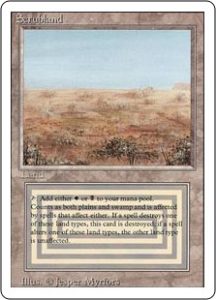
Scrubland in my mind is the trickiest of the three to evaluate. It’s very similar to Karakas in that it has a high individual floor and the same downsides, but the ceiling for Scrubland is so much lower. Instead, Scrubland’s main power is that it combos with basic Forest. The play pattern of turn one Forest + mana dork, turn two fetch Scrubland unlocks all of your colors and doesn’t overexpose you to Wasteland. If the Scrubland gets Wasted, you’re never knocked off your primary color. Basic Forest anchors the deck and Scrubland complements it so well that in my mind it warrants the inclusion.
Next I want to talk about some lands that aren’t included. These are cards I most often see added to decks without the appropriate concessions made to account for them. In other words, if you’re adding these cards to your deck and not planning around them, you’re likely harming your consistency and ability to execute your gameplan.
Basic Plains: To decide whether to include basic Plains, first think about the spells we’re casting with it. In the main deck, it’s Thalia, Knight, Gaddock Teeg, Renegade Rallier, and removal spells (Swords and Prismatic Ending). Now think about the scenarios where you might want Plains instead of Savannah: versus Wasteland and Blood Moon. Against Wasteland, it’s likely that you only want Plains after you already have Forest out. This is because the Plains is not doing you much good if the Wasteland you’re trying to beat knocks you off green. Green mana is simply more important to the deck than white mana. I view the scenarios where you want basic Plains as somewhat narrow and not outweighing the cost of Plains showing up in your opening hand, or ending up as the only land on the board. Since basic Plains moves you down the consistency axis and not over very far in the power axis, I see it as more of a metagame call than a core part of the deck.
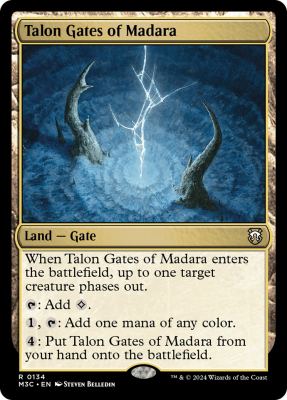
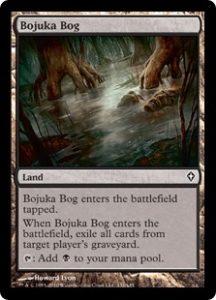
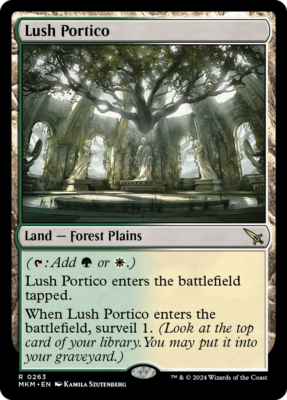
The next group of cards I want to talk about are individually powerful, but do not do enough on their own to warrant inclusion in my opinion. Lush Portico, Bojuka Bog, and Talon Gates of Madara are not bad individually, but they all fail to meet one or both of the consistency criteria I outlined above. This means that to justify them, the power they add to the deck needs to outweigh the consistency issues they introduce.
Bojuka Bog and Talon Gates in particular are lands that are at their best when you’ve already untapped with a Knight. In those scenarios they are outstanding, but that is only once you’ve gotten to turn three or later. The speed of the format has made them less powerful, which means their relative cost to your consistency has increased.
Lush Portico (and other surveil lands) are certainly a defensible choice, but their inability to tap for green on turn one and their potential to force you to play off curve puts a high price on the effect (power) to outweigh the inconsistency it creates. In a vacuum, I think the ability to surveil off any fetch may still outweigh the ETB tapped. However, nothing exists in a vacuum. In my mind, the tiebreaker for the exclusion of surveil lands is the fetching patterns they create. The incentive to proactively fetch a land harms your ability to consistently put forth threats and have good draws. You’re turning a three-color land that is impervious to Wasteland into a two-color land that opens yourself up to potentially getting hated off a color. Earlier in this article I brought up protecting my mana by only fetching for the splash color when needed. On top of their other costs, surveil lands open your mana up to hate.
Building in power without sacrificing consistency
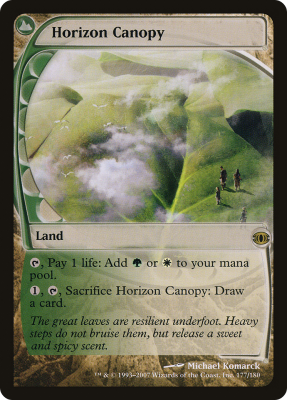
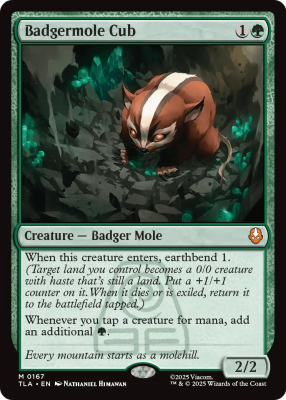
The newest changes to my land base have been the inclusion of both Nurturing Peatland and Horizon Canopy. These lands fall in a favorable spot on the power/consistency curve where they both tap for green in the early game, tap for two colors, and come into play untapped to allow you to cast spells on curve. The downside of losing a life for every tap can be real, but in my experience Legacy right now does not punish losing little bits of life very much. The piece that puts these lands over the edge, though, is the inclusion of Badgermole Cub and Icetill Explorer. Now, rather than just cycling itself, a Horizon Canopy can go card positive with Badgermole, or turn into an engine with Icetill Explorer. This provides a powerful late game at a fairly low cost to the manabase and, importantly, without hurting your ability to execute the Maverick gameplan consistently.
In conclusion, when building a Maverick deck, it’s important to keep in mind what makes Maverick good: consistency. The further you stray away from prioritizing consistency, the harder it’s going to be to win in the long run. In the case of Abzan Maverick, since adding a third color inherently makes your mana less consistent, achieving the level of consistency you need comes at a cost. The power-to-consistency curve can help you evaluate whether the power of a card is worth the harm it will bring to your manabase and deck’s strategy overall. It provides a framework for thinking about the opportunity costs of cards in your deck and hopefully will make you a better deckbuilder.
A big thank you to Alex for writing this article and sharing it through the ‘Zenith. If you’re wanting to catch his content or reach out, you can find him via YouTube, Twitch and within the Maverick Discord (Stancil9). Not only did he provide a decklist and great content, but he was able to Top 8 the Legacy Challenge the same weekend!
A huge shout to the Maverick and wider Legacy community in general – keep being good to each other.
Play fair, take care
Douges