Graveyard-based strategies have always been a fundamental part of Legacy, and any deck that wants to win games in the format needs a plan for interacting with them. Maverick is no exception, regardless of whether you’re playing casually or tuning a list for events, ignoring the graveyard is not an option.
One of Maverick’s strengths is its access to a broad range of graveyard interaction through creatures, artifacts, and utility lands, while also having access to non-permanent interaction (Surgical Extraction). That flexibility gives the deck real game against graveyard strategies, but it also introduces difficult choices when deciding which tools belong in your 75.
This article takes a practical look at the most effective graveyard interaction available to Legacy Maverick, with a focus on what actually improves your chances of winning games and how to apply those tools across common matchups.
If you’re someone who liked to watch content rather than read, I have you covered!
Note in this video I’ve had a brainfade and mentioned Reanimate as the card that was recently banned, not Entomb (which is the correct card). I’ll review the video and upload another version soon.
Table of Contents:
What’s considered a graveyard strategy?
How does Maverick use its own graveyard?
What are the main decks in Legacy that use the graveyard?
What are the main cards we are wanting to remove from these decks?
How much graveyard hate should I run?
Maverick’s Options for Graveyard Hate
Endurance
Scavenging Ooze
Leyline of the Void
Surgical Extraction
Bojuka Bog
Tormod’s Crypt
Nihil Spellbomb, Soul-Guide Lantern & Thran Foundry
Klothys, God of Destiny
Other Options
Extirpate (lol)
Faerie Macabre
Ashiok, Dream Render
Containment Priest
Anafenza, the Foremost
Kunoros, Hound of Athreos
Conclusions
What’s considered a graveyard strategy?
This isn’t always easy to define, but when I think of a graveyard strategy, I’m generally referring to an archetype whose primary route to victory is severely weakened or fundamentally altered without access to the graveyard as a resource.
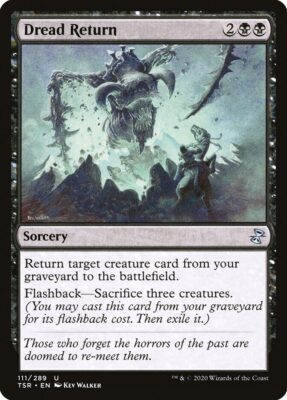
At the top end of the spectrum are decks like Oops All Spells and Dredge. These strategies rely heavily on cards such as Dread Return as part of their core game plan and primary win condition. Without access to the graveyard, the way these decks win games is either significantly slower and more “fair” (often creature beatdown), or shifts entirely to an alternative post-board plan, such as Goblin Charbelcher out of Oops All Spells.
Since the banning of Entomb, we’ve seen significantly less Reanimator in Legacy, though it still belongs in the graveyard-dependent category outlined above. Reanimator decks traditionally rely on the graveyard as their primary engine, and without it their core game plan is heavily disrupted.
That said, Reanimator has historically been resilient to hate, often incorporating sideboard “juke” plans to play around graveyard interaction. These commonly include pivoting into Show and Tell packages or adopting low-cost creature plans that allow the deck to apply pressure without fully relying on the graveyard.
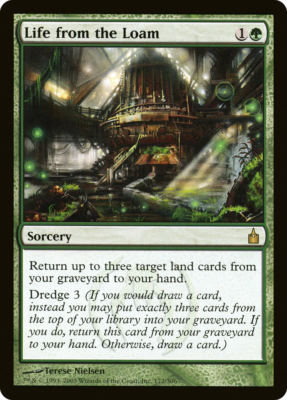
Next are decks like Lands, which make extensive use of the graveyard as part of their engine through cards like Life from the Loam. While graveyard interaction can meaningfully disrupt Lands, the deck is still capable of winning matches thanks to threats like Dark Depths and Urza’s Saga. Its primary win conditions aren’t graveyard-based, but the graveyard remains a major resource when building a plan to pull ahead.
I would place Painter variants in this category as well, particularly red-based builds using Goblin Welder and Goblin Engineer. These decks generate value and gain advantage through the graveyard, but access to the yard isn’t critical to executing their core game plan.
Cephalid Breakfast is another good example of a deck that uses cards like Dread Return and actively tries to combo opponents via the graveyard, yet still retains strong midrange and fair-game plans when graveyard access is shut down.
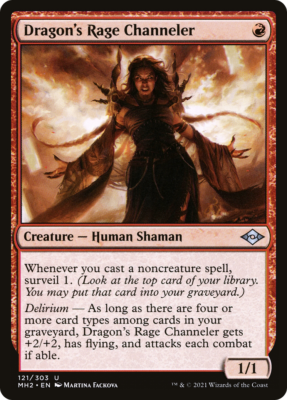
Finally, there are decks that aren’t reliant on the graveyard, but still benefit from it incidentally. Examples include UR shells with Dragon’s Rage Channeler and Murktide Regent, UB variants with Nethergoyf, Barrowgoyf or Tamiyo’s ability to return spells, or even GW Depths and Maverick, which leverage cards like Elvish Reclaimer, Knight of the Reliquary, Life from the Loam, Ramunap Excavator, or Icetill Explorer. These decks can generally win through graveyard interaction without much trouble, but may do so less efficiently or lose some of their ability to close games quickly.
How does Maverick use its own graveyard?
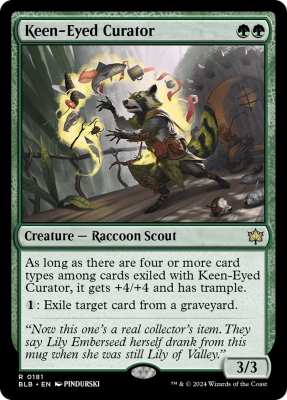
Legacy Maverick uses its own graveyard in several important ways. Knight of the Reliquary relies on lands in the graveyard to become a meaningful threat to an opponent’s life total. Scavenging Ooze — and the newer Keen-Eyed Curator, both require cards in graveyards to grow into larger threats, with Ooze also providing incidental life gain.
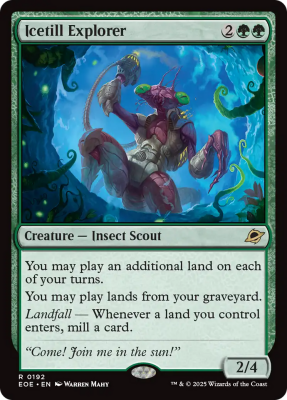
Maverick also generates value from the graveyard through recursion. Cards like Renegade Rallier allow you to return small permanents, while land-based recursion from Ramunap Excavator or the more recent Icetill Explorer lets Maverick repeatedly access utility lands and maintain pressure over longer games.
It’s worth noting that since the printing of Keen-Eyed Curator and Icetill Explorer, we’ve seen a noticeable decline in the number of lists running Ramunap Excavator, and especially Scavenging Ooze. Ramunap may be a littler harder to be replaced by some players who see the value in a 3cmc card vs a 4cmc in a Daze-heavy format.
In short:
-
Knight of the Reliquary needs lands in the graveyard to become a formidable threat and stay out of range of Lightning Bolt–style removal. Maverick players actively put lands into the graveyard via fetch lands, Wasteland, and other land interactions to maximise Knight’s size.
-
Ramunap Excavator allows Maverick to consistently make land drops, apply Wasteland pressure, and generate card advantage, particularly when paired with lands like Horizon Canopy.
-
Renegade Rallier recovers fallen creatures, lands, or other small permanents, while Endurance can recycle cards back into your library for additional use later in the game.
-
Keen-Eyed Curator and Scavenging Ooze (now less commonly seen) provide incremental life gain and can become game-ending threats by leveraging previously fallen creatures.
A few quick tips.
The duo of Sylvan Safekeeper and Knight of the Reliquary might win the game out of nowhere as you can grow the Knight to lethal.
To get additional value from enter the battlefield lands like Bojuka Bog or Talon Gates, you can Wasteland them and then replay them from the graveyard to trigger them once more.
Less important now, but cards like Ooze and Keen-Eyed were imporant vs UB decks as they stopped your opponents from being able to Reanimate not just their creatures but also your own.
Have another tip? Let me know in the comments of this article and I’ll add it in.
Because Maverick derives so much value from its own graveyard, the deck rarely runs fully symmetrical graveyard hate like Rest in Peace, unless the metagame demands a particularly heavy-handed answer.
To review where Maverick uses the graveyard:
| Mechanic | How Maverick Uses It |
|---|---|
| Knight of the Reliquary | Gets huge by virtue of lands in your yard |
| Ramunap Excavator / Icetill Explorer | Retrieves lands to fuel Knight and consistency |
| Scavenging Ooze / Keen-Eyed Curator | Disrupts opponent and grows off your own graveyard |
| Renegade Rallier / Endurance | Reclaims value from cards in the graveyard |
What are the main decks that use the graveyard as a resource?
Below is a quick breakdown of the most common Legacy archetypes that demand some level of graveyard interaction. Not every deck relies on the graveyard in the same way, so understanding how dependent an archetype is can help inform which hate pieces are most effective.
‘All-In’ graveyard based decks:
Archetypes whose primary game plan relies heavily on access to the graveyard in order to win the game:
- Oops all Spells
- Dredge
- Other graveyard-centric combo decks, such as Cephalid Breakfast (although still has a solid midrange plan on the surface.
- Reanimator (which sees considerably less play as of the banning of Entomb, but still falls squarely into this category)
Against these decks, shutting off the graveyard often forces them into slower, less reliable backup plans, if they have one at all.
Combo decks:
Archetypes that use the graveyard as a meaningful resource, but are more capable than “all-in” decks of winning games without it:
- Storm variants (Don’t overcommit here — the primary graveyard-relevant cards to consider are Echo of Eons, Gaea’s Will, Cabal Ritual and on the rare occasion Past in Flames)
- Lands
- Painter
Graveyard interaction can be impactful in these matchups, but rarely functions as a complete lock on its own.
Midrange decks:
Archetypes that leverage the graveyard for incremental advantage, but are by no means shut off from executing their core strategy without it:
Against these decks, graveyard interaction is often about slowing down their engine or reducing efficiency, rather than fully disabling their game plan.
What are the main cards we are wanting to interact with or remove from these decks?
Below is a matchup-focused breakdown of the key cards worth interacting with or removing when facing common graveyard-reliant Legacy archetypes. Not every deck folds to graveyard hate in the same way, so prioritising the right targets is often more important than exiling everything.
Oops all Spells:
Dread Return, Thassa’s Oracle, combo-enabling creatures such as Poxwalkers and Narcomoeba
Pro tip: Watch out for cards like Jack-o’-Lantern and Memory’s Journey in the graveyard, as they can completely blow out plans that rely on exiling key, game-winning cards. If your opponent has access to a single non-green mana, they can exile Jack-o’-Lantern at instant speed to generate green mana and flash back Memory’s Journey in response. From their, your opponent most likely puts 2 Lotus Petal and Oracle into the pile and wins over the next few turns.
Cephalid Breakfast:
Dread Return, Narcomoeba, Cabal Therapy
Dredge:
Bridge from Below, Dread Return, Hogaak, dredge creatures.
Pro Tip: When Evoking Endurance against Bridge from Below, stack the 2 triggers so that Endurance dies first, then tuck your opponents graveyard. This allows you to exile any Bridge from Belows (as your creature died) before they go back into your opponents deck.
Note: Even if you’re not a Dredge player or enthusiast, I highly recommend checking out MahfuzVanGogh’s content on YouTube. It’s consistently high-quality gameplay and a great example of deck knowledge overpowering perceived tier and metagame rankings.
Lands:
Life from the Loam, Loam targets (good to exile lands when possible in case of opossing Elvish Reclaimers / Crucible of Worlds / Endurance getting their lands back into the deck / Echoing Deeps)
Storm:
Past in Flames, & Echo of Eons (if possible). Keep them off cards in general for Gaea’s Will and Cabal Ritual (threshold). Also look out for that Runehorn Hellkite tech.
Affinty / 8-Cast:
Typically only Emry which I try to answer with Karakas rather than bringing in graveyard hate.
4C Control:
Uro, Snapcaster or Mystic Sanctuary targets
URx Delver:
No specific card but more to control Dragon Rage Channeler and ability to cast Murktide Regent
Maverick / GWx Depths:
No specific card but keeping it low is optimal. See above for what these decks rely on.
Additional notes:
- Stoneforge Mystic builds most likely are running Pre-War Formalwear. Although I wouldn’t bring in interaction for this, it’s nice to know our maindeck creatures are great ways to interact.
- Some control decks may play a copy of Mystic Sanctuary so that’s something to always consider alongside Uro or the odd Snapcaster
Although we don’t see these decks too often these days, for historic reference:
Reanimator:
Reanimation targets, Faithless Looting
Hogaak:
Bridge from Below, Hogaak, Arisen Necropolis, Vengevine, Bloodghast, Gravecrawler, Cabal Therapy
Madness:
Vengevine, Faithless Looting, Anger
NicFit:
Cabal Therapy – however, really no specific card other than Academy Rector in NixFit builds.
Tin Fins:
Griselbrand
Bombermann:
Lion’s Eye Diamond, Walking Ballista.
Urza Echo:
Emry, Lurker of the Loch targets, Echo of Eons
How much graveyard hate should Maverick run?
Below is a chart from Frank Karsten’s CFB article, How Many Copies of Any Given Card Should You Put in Your Deck? This is an excellent resource for determining how much graveyard hate to include in your deck, helping ensure you have it available in your opening hand. I would generally recommend running 5–7 pieces in your 75.
Note: Unfortunately, CFB, like many other major Magic content sites, has struggled with site migrations, so accessing older resources can sometimes be tricky (as they weren’t carried over).

Maverick’s Options for Graveyard Hate:
MVP. Endurance
Buy on TCG | Buy on Cardhoarder
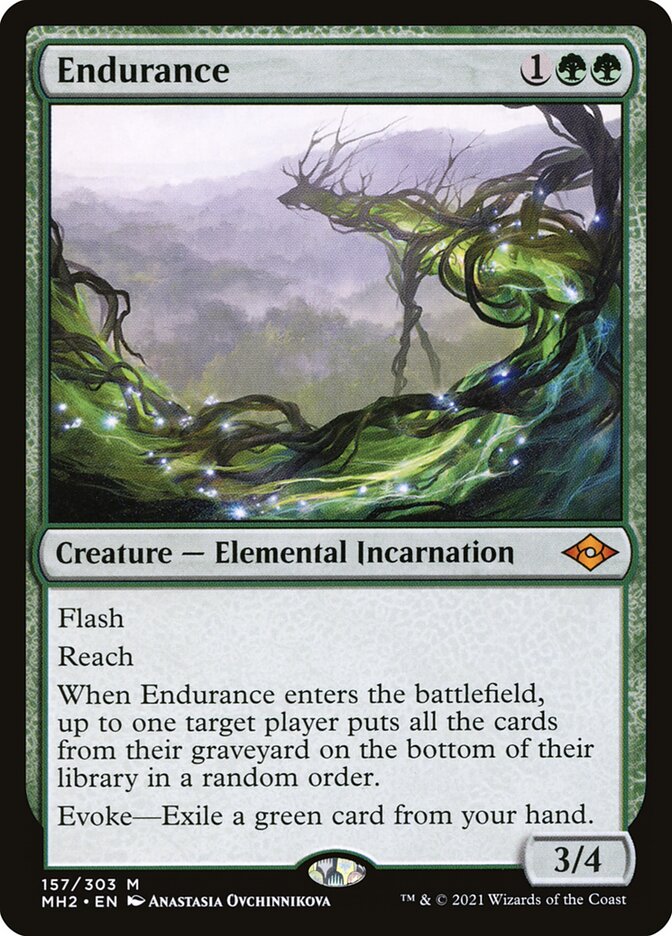
Endurance has arguably been the best printing for Maverick in 2021. It’s not only impressive graveyard hate, but also a solid threat against a variety of decks. It performs well against Delver, serves as a strong threat against control, and provides Maverick with some turn-0 interaction against fast combo decks. If you’re playing any build of Maverick, I’d recommend including at least 2–3 copies in your 75.
Endurance is a great example of a flexible hate piece that works in multiple matchups — exactly what a fair deck like Maverick needs. I wouldn’t include a card as specific as Doomsday hate just based on one matchup’s win percentage; instead, you want a card that can contribute across the board. Endurance fits that role perfectly, providing “splash damage” in a wide range of matchups.
Not only is it effective against opposing graveyard strategies, but it also lets you tuck cards from your own graveyard back into your library, making them accessible again with Green Sun’s Zenith, Knight of the Reliquary, or simply giving you another chance to cast them.
Lastly, Endurance can be found via Once Upon a Time which can come in handy when up against fast combo decks.
Pro Tip: In a really tight spot, an evoked Endurance can also provide the mana you need via a Gaea’s Cradle. It can also be a way to save a 3/3 Ooze from Bolt or a Curator from an Unholy Heat that just needs a creature to eat!
Keen-Eyed Curator
Buy on TCG | Buy on Cardhoarder
Keen-Eyed Curator is exactly what Maverick has been looking for when it comes to upgrading its long-standing creature base (okay, maybe not a full 2012–2014 overhaul — but seriously, give us Leovold in Abzan colours already).
It’s a fantastic threat: Green Sun’s Zenith–able, proactive, and capable of providing incremental graveyard interaction that quickly turns a 3/3 into a fast, difficult-to-answer clock. Outside of mana-dork starts, it can be slightly harder to cast than Scavenging Ooze, but in practice this is rarely a meaningful issue. More importantly, Curator’s ability not requiring green mana is a huge upgrade over Ooze — one that many players don’t fully appreciate until they’ve played with it.
You can also “skip” cards using Curator’s static ability when dealing with cards that have multiple card types. Urza’s Saga is a great example, as it’s both an enchantment and a land, as is Painter’s Servant, which is both an artifact and a creature.
While Keen-Eyed Curator doesn’t gain life like Scavenging Ooze — something that can matter in matchups involving Lightning Bolt — its ability to close games much more quickly often renders that downside largely irrelevant.
One of the most underrated strengths of cards like Curator is that they are proactive, not reactive, unlike many traditional approaches to fighting graveyard strategies. With maindeck access via Green Sun’s Zenith, adding even a single copy effectively gives you up to five ways to find it. This allows Maverick to steal game ones it otherwise wouldn’t have a chance at, and forces graveyard-based decks to play more honestly.
Even against decks that don’t rely on the graveyard, Keen-Eyed Curator applies pressure, grows naturally over time, and demands an answer — exactly what you want from a maindeck slot in Maverick.
What’s Keen-Eyed Curator’s level of impact against ‘all-in’ graveyard decks?
Significantly higher than Scavenging Ooze.
Keen-Eyed Curator applies pressure and graveyard interaction simultaneously, which is exactly what Maverick needs against all-in strategies. Because Curator’s exile ability does not require green mana, you’re free to develop your board, hold up interaction, or apply a clock without sacrificing tempo.
Against decks like Dredge, Reanimator, or Oops All Spells, Curator forces opponents to act earlier and more honestly. It steadily eats away at critical resources while growing into a fast, lethal threat. This often compresses the opponent’s window to combo, turning games that would otherwise be unwinnable into races that Maverick can actually compete in, especially when Curator is tutored via Green Sun’s Zenith.
What’s Keen-Eyed Curator’s level of impact against combo decks?
Very strong.
Unlike Scavenging Ooze, Keen-Eyed Curator doesn’t require early mana acceleration to be relevant. While it still usually comes down on turn two or three, the key difference is that Curator immediately pressures both the opponent’s life total and their graveyard without demanding additional mana investment.
This makes it far more effective against combo decks that rely on graveyard setup but aren’t strictly all-in. Curator’s ability to grow quickly while disrupting resources reduces the number of turns combo decks have to sculpt a winning hand, often forcing them into suboptimal lines or premature attempts.
What’s Keen-Eyed Curator’s level of impact against midrange decks?
Excellent.
In midrange matchups, Keen-Eyed Curator functions as a self-contained threat that naturally scales as the game progresses. It invalidates common value engines such as Uro and Life from the Loam, while simultaneously becoming a large, difficult-to-answer attacker.
Because Curator grows off any graveyard interaction, including incidental exchanges, fetchlands, and traded creatures, it rarely sits idle. Even when graveyard hate isn’t strictly required, Curator applies consistent pressure and demands an answer, making it a proactive inclusion rather than a situational one.

Scavenging Ooze
Buy on TCG | Buy on Cardhoarder
Scavenging Ooze is the embodiment of what a Maverick player loves, a literal hate-bear. A hate-bear is typically a two-mana 2/2 creature that comes with a disruptive element attached, such as Gaddock Teeg or Ethersworn Canonist.
Scavenging Ooze has been a maindeck silver-bullet staple in Maverick since its printing, and it remains a strong way to interact with opposing graveyard strategies in game one. Common G1 targets for Ooze include Uro, Life from the Loam targets, and, if you’re lucky, a reanimation target before it hits the battlefield.
Ooze fits naturally into the maindeck; however, in the current Legacy landscape, I wouldn’t prioritise it over Keen-Eyed Curator.
Scavenging Ooze does exactly what it’s designed to do: it picks off individual cards from graveyards and exiles them for the cost of a single green mana. That said, Curator performing a similar role without a coloured mana restriction is a substantial upgrade.
Beyond the mana advantage, Keen-Eyed Curator also scales into a significantly faster clock while providing proactive, ongoing pressure, something that matters far more in modern Legacy than incremental life gain.
While Scavenging Ooze still has applications, particularly in longer, grindier games, Curator has largely surpassed it as the more efficient and impactful maindeck graveyard interaction for Maverick today.
What’s Scavenging Ooze’s level of impact against ‘all-in’ graveyard decks?
You can deal with a full graveyard using Scavenging Ooze, but doing so often requires committing large amounts of mana over multiple turns. This usually comes at the cost of developing your own board state, which is a real liability against decks designed to kill you quickly.
Yes, you may have access to Gaea’s Cradle, but if it’s producing more than three mana, you’re often already in a position where you’re winning via a beatdown plan rather than because Ooze successfully locked the opponent out of their graveyard. In practice, Scavenging Ooze tends to be too slow and mana-intensive to reliably shut down true “all-in” graveyard strategies on its own.
What’s Scavenging Ooze’s level of impact against combo decks?
Scavenging Ooze can come online as early as turn two on the play if you open with a mana-producing creature like Noble Hierarch. However, on the draw, and especially without early acceleration, Ooze is often simply too slow to meaningfully interact with fast combo decks such as Oops or Dredge.
In these matchups, graveyard interaction needs to either happen immediately or come stapled to zero or one-mana interaction. Ooze’s reliance on both timing and repeated green mana activations makes it an inconsistent answer against the fastest combo strategies in the format.
What’s Scavenging Ooze’s level of impact against midrange decks?
Still very good.
An unanswered Scavenging Ooze can take over a game in just a few turns. It’s a threat that invalidates Snapcaster Mage, shrinks Goyfs down to irrelevance, and turns your fallen creatures into future pressure and life gain. Against midrange decks, the slower pace of the game gives Ooze the time and mana it needs to shine.
For its speed and mana requirements, Ooze’s best matchups are clearly against midrange strategies rather than the faster “all-in” or combo decks discussed above.
Leyline of the Void
Buy on TCG | Buy on Cardhoarder
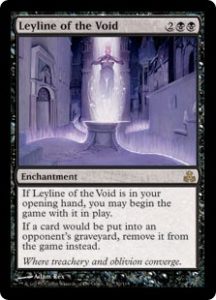
Leyline of the Void is a great option for graveyard-hate in the sideboard because it’s a turn-zero interaction that plays around everything from countermagic, discard spells and even Chancellor triggers. Being an enchantment it’s a little harder to deal with than artifact hate (however, be weary of cheap bounce effects from Dredge and Storm decks and Force of Vigor from Oops.
The current Mulligan rule also improved the chances of having not only a Leyline in your opening hand, but also a hand with a decent game plan.
Too many times I’ve seen players across all formats keep a hand with a Leyline and no real game plan, then go on to lose because they just didn’t have anything to back it up.
Here’s a great example of Tom Ross on Dredge doing this against Jund when his opponent opened on a turn-zero Leyline. Make sure you’re not relying soley on Leyline, as it’s more of a speed bump than a hard lock piece for most opponents. Typically a big benefit of Leyline is that is buys you the time to build out your board of further disruption.
You have a 39.9% chance of having Leyline in your opening hand if you play the full playset, that % drops to 31.5% if you only run 3. Drawing Leyline’s is a rough feeling but if you’re a GWB Maverick player, you have the added bonus of being able to cast them later in the game.
What’s Leyline of the Void’s level of impact against ‘all-in’ decks?
Huge. The one downside of Leyline is that it happens before your opponent has committed to the graveyard. What I mean by this is I would rather my opponent ‘go for it’ only to be hit by Surgical than for my opponent to see the Leyline, then craft a plan to remove it and quickly take over the game.
What’s Leyline of the Void’s level of impact against combo decks?
Leyline can be hit or miss against these types of decks. Storm doesn’t always need its graveyard to go off in the early turns and decks like Cephalid Breakfast have a great midrange plan.
Outside of those who play Life from the Loam, Leyline doesn’t really do anything against Dark Depths either. Sure, Lands is a little more orientated towards the graveyard but once they see Leyline they can ‘play around it’. What I mean by this is they have the ability to not commit to the graveyard until they find their Boseiju or Force of Vigor.
If they also just have the combo together they may not even need to get Dark Depths and Thespian’s Stage back from the graveyard. I would still bring it in against Lands but I would find Surgical Extraction to be a little better at devastating your opponent’s plans.
What’s Leyline of the Void’s level of impact against ‘midrange’ decks?
It would have to be a deck that relies heavily on the graveyard like Lands or Hogaak for me to consider Leyline. Even against something like Cephalid or GW Depths I don’t feel it’s the type of hate we need and can lead to some awkward hands and draws.
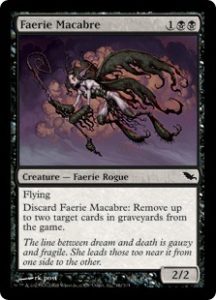
Faerie Macabre
Buy on TCG | Buy on Cardhoarder
Another ‘free’ creature option worth discussing is Faerie Macabre. It offers an uncounterable answer to graveyard decks and can create truly devastating moments for an opponent when you exile a key card (or two) from their graveyard in response to a spell or targeting.
Faerie Macabre is excellent at what it does: sniping specific cards from graveyards at instant speed and completely out of nowhere. What it doesn’t do well is meaningfully disrupt decks that treat their entire graveyard as a resource. Yes, it can feel great to exile Bridge from Below and a Narcomoeba with a trigger on the stack, but you’re still left dealing with the rest of the graveyard afterward.
Functionally, Faerie Macabre plays much like Surgical Extraction. It’s instant-speed interaction that can be used from turn zero, making it a reasonable budget alternative to Endurance against fast combo decks. It also has some unique advantages:
- It plays cleanly around Chancellor of the Annex triggers
- It can be found with Once Upon a Time
- Abzan can cast it if you’re in a situation where you want a threat
- Although Exhume doesn’t see much play anymore, it does exactly what you think it does if your opponent has 2 or less creatures
What’s Faerie Macabre’s level of impact against ‘all-in’ decks?
Faerie snipes cards. It doesn’t really perform well when you’re wanting to answer a whole graveyard. Against Dredge, it can buy you time against the fast starts to plant creatures – but it’s no Leyline of the Void.
Against Oops, your opponent is likely to cast Cabal Therapy if they sniff out Faerie or have the mana available for the Jack / Journey line mentioned above. It can still catch some players offguard who might think to name Endurance, so having muliple pieces of instant speed interaction works well vs Therapy.
It was one of the best cards you can have against Reanimator as without hand disruption, it just performs so well.
Did your opponent reveal Chancellor and try to just go off on the play? Too bad Faerie plays around Chancellor’s ability.
Faerie is better when it comes to the make-or-break moments like your Dredge opponent targeting a creature with Dread Return or your Reanimator opponent casting a payoff spell like Reanimate, Animate Dead or Exhume. With two creatures in their graveyard, Faerie is better than Surgical Extraction in many cases (especially when it comes to Exhume).
What’s Faerie Macabre’s level of impact against combo decks?
Moderate, but often underwhelming.
Faerie is serviceable against combo decks, but it can feel lacklustre compared to more comprehensive options. You can disrupt Storm by keeping them off threshold for Cabal Ritual, or by removing an Infernal Tutor in response to a big Past in Flames turn, but these lines are often narrow.
Similarly, exiling a lone Life from the Loam or Punishing Fire can sometimes be enough to stabilise, but more often it feels like a band-aid over a bullet hole. Against combo decks that aren’t fully dependent on specific graveyard cards, Faerie tends to fall short.
What’s Faerie Macabre’s level of impact against ‘midrange’ decks?
Low.
This is generally not where you want to be bringing in Faerie Macabre. Siding it in against other fair midrange decks just to try and catch a Snapcaster Mage flashing back Brainstorm or Swords to Plowshares is rarely worth the card slot.
That said, if your opponent is clearly relying on repeatable graveyard value — such as Life from the Loam or another engine that provides steady incremental advantage — Faerie may still deserve consideration. In most cases, however, Maverick has access to more flexible and impactful post-board options.
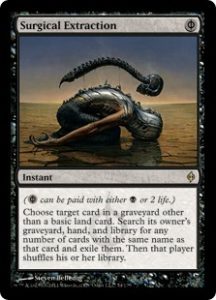
Surgical Extraction
Buy on TCG | Buy on Cardhoarder
Surgical Extraction is by far the most versatile graveyard hate card in Legacy – and for good reason. At the mere cost of 2 life (or a single black mana) you can rip apart your opponent’s game plan. Surgical does have the gotcha clause of coming free and straight from your hand, unlike options like Scavenging Ooze or Tormod’s Crypt where your opponent knows about the threat of fallout. Although we’ve received new printings in recent years, I believe Surgical is still one of the best sideboard options for graveyard hate in Maverick.
Pro Tip:
Always be aware that the majority of the time, Surgical Extraction is going to be card disadvantage. Have a good think before you side it in against your opponent and what you’re wanting to target. Is a well-timed Surgical going to break their game plan, or are you overthinking its importance in the matchup? Surgical against Reanimator or Lands? Great – you’ve got some specific cards that are going to slow down or completely obliterate their plan. Surgical against Delver to remove Lightning Bolt? Not so great.
What’s Surgical Extraction’s level of impact against ‘all-In’ decks?
Pretty fantastic. Surgical is great at sniping out not only targets in graveyards but also removing them from your opponent’s hand and library. However, there are downsides. Surgical isn’t great against Exhume when your opponent has 2 different and powerful threats in their graveyard, or on the draw after your opponent has revealed a Chancellor of the Annex. With cards like Tormod’s Crypt or Faerie Macabre, you are only hitting (most of the time) one copy of a card and buying yourself 1 or 2 turns. Imagine removing all copies of Griselbrand from Reanimator or facing Dredge without Bridge from Below – not as scary, right?
What’s Surgical Extraction’s level of impact against combo decks?
Still OK. ANT without a Past in Flames line? Lands without Life from the Loam? Depths without… Dark Depths? Surgical is great against the combo decks that rely on 1 or 2 cards to muster a win. Sure, a Storm player without access to Past in Flames could just try and go off without it, or a Lands player could try to beat down with their Vampire Hexmages and Elvish Reclaimers alone, but it’s a much different threat compared to with those specific cards.
What’s Surgical Extraction’s level of impact against ‘midrange’ decks?
Many of these decks don’t rely on any specific cards from the graveyard, so I wouldn’t bring it in unless you’re really wanting to target specific cards. I don’t mind bringing in Surgical Extraction against Miracles if I also have access to Thoughtseize post-board. Being able to take removal like Swords to Plowshares or Terminus or a win condition like Monastery Mentor or Jace, the Mind Sculptor then not have to worry about it for the rest of the game is a fantastic feeling. However, the majority of the time you’re putting yourself down a card. I wouldn’t say this is a clear strategy to have against UWx but it’s worked for me in the past but with Prismatic Ending in the format this just isn’t worth it considering how much card advantage is worth in these matchups.
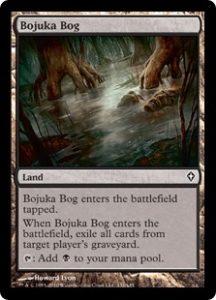
Bojuka Bog
Buy on TCG | Buy on Cardhoarder
I’ve always been on the fence about Bojuka Bog in Maverick. It gets a little better if you’re running a Crop Rotation package in the sideboard, but even then I believe Bog is simply too slow to rely on against many of the faster graveyard decks in the format.
Graveyard interaction is at its best when it happens at instant speed, and that’s something traditional Maverick can’t realistically achieve with Bojuka Bog until turn three — and that’s assuming you’ve opened on a mana dork, your Knight of the Reliquary survives, and you’re not already dead. Elvish Reclaimer builds can technically fetch up Bog as early as turn two, but that line costs you a land and your entire turn, which is a steep price to pay against decks that are trying to kill you immediately.
I also think the fact that Bojuka Bog is a land, and therefore searchable with Knight of the Reliquary, gives it more credit than it deserves. That searchability can be deceptive and often leads players to overvalue the effect compared to more efficient, flexible graveyard hate spells. In practice, there are simply better options available to Maverick that apply pressure, interact earlier, or do both at once.
Pro Tip:
If you already have Bojuka Bog in play but need to exile your opponent’s graveyard before their next turn, you can destroy it with your own Wasteland or sacrifice it with Elvish Reclaimer and then play it from the graveyard with Ramunap Excavator for another trigger.
What’s Bojuka Bog’s level of impact against ‘all-in’ decks?
Slow.
Unless you’re playing some number of Crop Rotation, I don’t believe Bojuka Bog is a reliable answer to fast combo decks. You have just under a 12% chance of drawing a one-of land in your opening hand, and a sorcery-speed exile effect simply isn’t what you want against decks that are trying to win on turns one or two.
If you’re leaning on Bojuka Bog as part of your graveyard-hate package, I strongly recommend supplementing it with faster interaction such as Surgical Extraction or Faerie Macabre to help shore up those fast combo matchups.
What’s Bojuka Bog’s level of impact against combo decks?
Still slow.
By now it’s probably clear that I’m not a fan of Bojuka Bog as an answer to combo decks unless you’re running a dedicated Crop Rotation package. Even then, the ceiling is fairly limited.
You have roughly a 15% chance (yes, we did the math* — thanks, Raymo!) of accessing Bojuka Bog by turn three via a turn-two Knight of the Reliquary. But if you’ve been given that much time, there’s a good chance your opponent is already stumbling or keeping a weaker hand — not something you can reliably count on.
What’s Bojuka Bog’s level of impact against ‘midrange’ decks?
Surprisingly reasonable.
As a mid-to-late-game graveyard exile effect, Bojuka Bog is much more defensible. Against the mirror, 4C Loam, or other decks that partially rely on their graveyard for incremental value, Bog can do real work without costing you a spell slot.
In these matchups, I’m far more comfortable with Bojuka Bog as a searchable utility land rather than a primary piece of graveyard interaction.
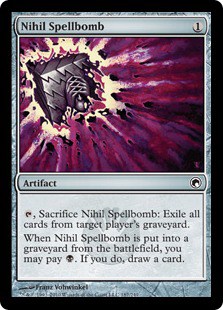
Artifacts: Tormod’s Crypt, Nihil Spellbomb & Soul-Guide Lantern
Buy on TCG | Buy on Cardhoarder
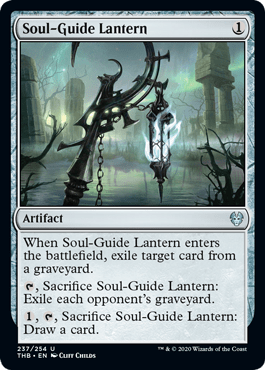
Nihil Spellbomb doesn’t see as much play compared to some of the other options discussed above. However, with the printing of Urza’s Saga, we’ve seen a noticeable uptick in artifact-based graveyard hate across Legacy. Soul-Guide Lantern often fills a similar role and has the bonus of value on entry (in some cases).
What’s Nihil Spellbomb’s and Soul-Guide Lantern’s level of impact against ‘all-in’ decks?
Moderate.
Unlike Tormod’s Crypt, these artifacts don’t have the luxury of playing around Chancellor of the Annex or Daze, but they make up for it by being a cantrip. They’re serviceable against fast combo decks, though Nihil Spellbomb only reaches its full potential if you’re splashing black and can draw a card on sacrifice.
One issue with cards like Spellbomb and Lantern is that skilled opponents can often bait their activation.
What’s Nihil Spellbomb’s and Soul-Guide Lantern’s level of impact against combo decks?
Acceptable, but not ideal.
Much like Tormod’s Crypt, these cards are generally fine against combo decks, but they’re rarely the kind of hate you’re actively hoping to draw. Their biggest upside is flexibility: once you’ve exiled your opponent’s graveyard, you can cycle the artifact to dig for additional interaction, allowing you to follow up with another disruptive spell and keep the pressure on.
That said, in many combo matchups, you’ll still prefer faster or more decisive graveyard interaction.
What’s Nihil Spellbomb’s and Soul-Guide Lantern’s level of impact against midrange decks?
Solid.
The biggest draw (no pun intended) to Nihil Spellbomb is its ability to replace itself. When you need to exile your opponent’s graveyard, the option is there, but if the graveyard isn’t immediately relevant, you can cash it in to dig for interaction or a specific card.
This flexibility makes Spellbomb and Lantern more attractive against midrange decks than one-shot options that don’t offer card selection, especially in longer games where incremental advantages matter.
Klothys, God of Destiny
Buy on TCG | Buy on Cardhoarder
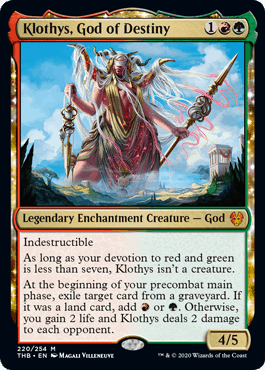
Although Prismatic Ending has given control and midrange decks a clean answer to Klothys, it remains a strong Green Sun’s Zenith target for Maverick. Klothys, God of Destiny is very slow and narrow as graveyard hate, but it’s excellent in matchups where you only care about exiling a small number of high-impact cards, such as Uro or a key Life from the Loam.
I wouldn’t rely on Klothys against combo decks or even semi-relevant graveyard strategies like Oops or Dredge. While its overall play rate has declined, I still like having access to a single copy in my 75 when playing Punishing Maverick, where the incremental damage and inevitability meaningfully contribute to the deck’s game plan.
Other Options:
Containment Priest
Buy on TCG | Buy on Cardhoarder
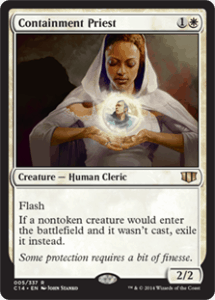
Containment Priest is an interesting case. It’s a card many players bring in against Maverick specifically to shut down the Green Sun’s Zenith engine. When building your own sideboard, though, you always need to ask a simple question:
“Does this hurt my opponent’s game plan more than it hurts mine?”
A good comparison is Gaddock Teeg in Maverick’s maindeck. Yes, it turns off our own Green Sun’s Zenith, but when it comes down against decks like Storm or Mono-Red Prison in game one, it can be completely backbreaking for the opponent. Containment Priest occupies a similar space, high impact in the right matchups, but not universally applicable.
What’s Containment Priest’s level of impact against ‘all-in’ decks?
Fantastic.
Containment Priest completely shuts down Dredge, Oops and Reanimator strategies (when you come across them) and, frankly, has caused more immediate concessions than almost any other sideboard card. When it sticks, many of these decks simply can’t function.
The biggest drawback is timing: you still need to survive long enough to cast it on turn two. Against the fastest starts, that window isn’t always guaranteed.
What’s Containment Priest’s level of impact against combo decks?
Narrow, but strong
The combo matchups where Priest actually shines outside of graveyard decks are against Show & Tell / Sneak & Show and Natural Order decks.
It has to be removed against most decks relying on cheating a big creature into play, outside of Omniscience into casting said creature.
What’s Containment Priest’s level of impact against ‘midrange’ decks?
Low, but occasionally relevant.
I generally don’t bring Containment Priest in for the Maverick mirror. I have sided it in against Death & Taxes in the past as extra hate for Aether Vial, but since the printing of Outland Liberator and Knight of Autumn, that role has largely been made redundant.
Pro Tip:
If you’re bringing in Containment Priest against Death & Taxes, make sure you don’t play yourself into your opponent getting free exiles on your own creatures. If you have a Priest and Knight of the Reliquary in play and your opponent casts Flickerwisp targeting the Knight, you’re not getting it back, ever.
Conclusions:
Endurance is by far the best thing you can be doing when attacking graveyard decks. Keen-Eyed Curator has the bonus of being a recurring piece of graveyard hate that also pressures your opponent but most of the time Endurance is just enough.
Leyline of the Void and Surgical still have some valid upsides, Surgical being another free spell that removes all copies of a card and Leyline playing around countermagic and having to be removed before going off. Faerie Macabre is also a strong sideboard card that fits well in Maverick’s creature strategy.
Although I’ve included a range of options above, I would say in a competitive environment, only the 4 above should be considered in non-Saga builds.
Here are some questions to ask yourself when considering what type of graveyard hate you should be yielding:
- Do I need specific target removal (Keen-Eyed, Surgical Extraction, Faerie Macabre) or a more blanket type effect to interact with my opponent’s graveyard (Leyline of the Void)? If both, Endurance.
- How will this impact my mulligan decisions? What sort of hand am I keeping that doesn’t include this card? (Really important when mulling for Leyline)
- Does this card impede my own game plan? If so, does it impede my opponent more?
- Can I rely on this to close out the game or is this only a speedbump for my opponent?
- What sort of removal / disruption would they have to answer this? Is there anything I can do to protect it?
A huge, huge thank you to all of you who made it this far. A big shout out to my current Patrons who allow me to keep this site running.
Take care, play fair
Douges